Showing posts with label art workshop. Show all posts

Monday, September 8, 2014

September / October blog for Whidbey Island FAS

Teresa Oaxaco will be doing a workshop at Whidbey Island Fine Art Studio in 2015.


“My work is about pleasing the eye. I paint light and the way it falls. Simple observation reveals beauty; often it is found in the unconventional. Because of this I have learned to take particular delight in unusual pairings of subject matter. Frequently my compositions are spontaneous. When a person comes to me, they occupy a space my mind. Arrangements form from there until with excitement I see and have the idea. The design is both planned and subconscious. For this reason I surround myself with Victorian and Baroque costume, bones, and other things which I find fascinating- I want subject matter to always be at hand.
My paintings are created with oil paint on canvas. I am conscious of the traditional craftsmanship I have attained in Florence. While my interest in new pigments and tools may cause minor alterations in my materials, these really remain fundamentally the same. All my evolution is taking place on the canvas and in my head; in what I see in nature and interpret in two dimensions on the picture plan. I have the fundamentals of design to work with when planning a painting. I make preparatory studies. I use multiple layers to build an illusion of light and form. When this illusion is convincing and to my taste, the painting is done.”
Teresa graduated at The Florence Academy of Art in 2010. Also was Life Drawing Instructor during that academic year.

Interview with Teresa some years ago.
Only Teresa Oaxaca could pull off this photo. She’s dolled up in  Victorian grandeur like a character that should have stolen the roles of Alice in Wonderland and Kirsten Dunst’s Claudia in Interview with the Vampire right out from under their  boring blond noses. Teresa’s sitting under a portrait of a somber girl with her hands folded praying to an unknown deity with a displaced tea set on the floor. She’s also holding a rat.
We talk to Teresa about her art, her Victorian era bodices, the Capuchin Crypt and vestigial tails.
1. What is your artistic background?
I started sculpting when I was pretty young. I had private instructors when my family moved to the Netherlands from 1996-1998. I went to school as soon as I could at the age of 17 (2005) in Florence, Italy. Everything I have accomplished so far would have been impossible without the training I received there – I am very influenced by the history of European painting, sculpture, and architecture.
2. Explain your spontaneous process.
Frequently my compositions are spontaneous. When a person comes to me, they occupy a space my mind. Arrangements form from there until with excitement I see and have the idea. The design is both planned and subconscious. Simple observation reveals beauty; often it is found in the unconventional. Because of this I have learned to take particular delight in unusual pairings of subject matter.
3. How would you define your style and its connection with your art?
The history of costume has been ever changing. I like to “cherry pick” from history, to take ideas from my travels and from books. I own a few authentic Victorian Era bodices however most of my clothes are modern reproductions or dresses inspired by past fashions. My clothing, like my painting technique, is heavily indebted to the past.
4. Tell us the inspiration and process behind one of your favorite pieces.
In “Remembrance,” Walter is the name of the skull in the painting. I bought it in Florence. When in Italy I visited the Capuchin Crypt. Since visiting this tunnel of death, it has recurred in my dreams and what was once a curiosity is an ominous memory…the small and yellowed skull, missing all but two teeth, utterly devoid of the occidentals and parietals is Walter… and like an old friend, I cannot keep it from my mind for long. Walter sits on your shelf; you dare him to make another appearance in one more painting.
5. What are your artistic stimuli?
I surround myself with Victorian and Baroque costume, bones…I ordered a few books on carousel horses and gothic art. Lately I have been interested in frame building and design. I think it is a shame that painting has distanced itself so far from architecture and sculpture to the point where it nearly becomes lumped in with photography. I like to think of modern wooden frames as “vestigial tails – leftovers from the days when a painting was made for an alter niche, and adorned with carved figures and intricate patterns of architecture.
for more details visit  http://www.teresaoaxaca.com


file:///Users/caryjurriaans/Desktop/Wig-Portrait3.jpg


Wednesday, August 20, 2014

Redefining Realsime by--Allison Allison Malafronte (senior editor of American Artist)

http://www.artistdaily.com/


Attempting to define realism or to clarify the various styles of representational painting can be a challenging task.  When writing about today's painters, I always hesitate to use words like "classical," "realist," "contemporary," "traditional," or "modern" because they do not always fully capture what I'm trying to describe. For example, a word like "classical" by definition refers to Greco-Roman or Renaissance ideals, but by connotation has come to mean an art form that embodies a certain timelessness and order. "Contemporary" undoubtedly means anything taking place in our time, so by that definition any painter alive is contemporary. But critically speaking, I would not call all painters today contemporary--I'm more apt to use that distinction when a painting has a more modern or conceptual feel.
The Desperate Man by Gustave Courbet, 1844-1845, oil painting, 17 3/4 x 21 5/8.
The Desperate Man by Gustave Courbet, 1844-1845, oil painting, 17 3/4 x 21 5/8.
Artists themselves have felt the confusion and in an attempt to bring clarity have adopted such labels as new realists, figurative realists, classical realists, contemporary realists, and so on. These phrases have found their meaning in a Post-Modern context, which generally defines what it is by comparing itself to what it is not. The New Realists of the early 1960s, for example, made it clear that they were not your grandmother's realists reveling in Caravaggio and Jacques Louis David but rather were trying to bring elements of representation to the Abstract Expressionist aesthetic. The Classical Realists of the early 1980s led by Richard Lack were differentiating their brand of realism from other forms of representational art of the time, even though they knew that within the context of art history "classical realism" was a contradiction in terms.
Realism can mean different things to different people and has changed meaning over time, which is another reason why it's difficult to define. Most would agree that realist painters are recognized by their choice of subject matter. Like Gustave Courbet--by most accounts considered the first Realist--or any of the Russian painters throughout history, a realist paints the real world and finds beauty and interest in everyday people, places, and things that the rest of society might find mundane. The realist is also defined by his or her technical execution, which aims for an accurate, truthful representation of the subject. The stylistic differentiation gets tricky among artists, however, because many realists who work from life do not want to be put in the same category as realists who work from photographs or in a  photorealistic manner. This confusion translates to the public, who will often comment that a painting looks like a photograph, as if that were the highest compliment one could pay an artist.
As you can see, the parameters surrounding realism are rather ambiguous. I think this is because realism is redefining itself as we speak and also because a new movement is on the horizon. I believe that movement will embody a language that is not yet in our artistic vocabulary, forcing us to find new words and a new criterion.

--Allison

Tuesday, September 3, 2013

Nourishment for Your Soul

With so many art workshops across the country and even internationally, choosing the right instructor and setting for an art class can be overwhelming. 

Why come to Whidbey Island for your next art class? What sets Whidbey Island Fine Art Studio (WIFAS) apart from other art studies offering art workshops? 


Our motto “Feeding the Artistic Soul” sums up what we do. A workshop at Whidbey Island Fine Art Studio will feed your artist's soul in three unique ways. 

1. Our picturesque, pastoral setting. 
Whidbey Island, located across the Puget Sound just 30 miles from Seattle, is a wonderful place for relaxation and tranquility. WIFAS’s location in Langley, a quaint historical village, offers views of the water. In addition, the island’s farms, forests, bluffs, and beaches provide the foregrounds to many aquatic vistas. The quiet and romantic surroundings that are so much a part of the Whidbey Island experience help to restore and feed every artist’s soul. Coming to a workshop at WIFAS is like taking a relaxing vacation with picturesque gardens and farms, and water, island, and mountain views in every direction. 

  
2. Personalized approach. 
Each workshop offered at WIFAS includes personalized instruction for the artists in attendance. There is always plenty of room for everyone to have their own easel with elbow room to allow creative juices to flow. We place an emphasis on utilizing seasoned artists who provide good instruction delivered in such a manner that it sticks with our attendees long after they go home, continuing to strengthen and nourish each soul. In addition, WIFAS ensures that our students’ needs are attended to, from delicious snacks to personal questions answered.


3. Class dinner. 
Every workshop presented by Whidbey Island Fine Art Studio includes a dinner hosted by Cary Jurriaans in her home for the instructor and all the students in the class. For many students, this dinner is a highlight of their time at WIFAS as they get to interact with their instructor and the other students in an informal, relaxed atmosphere. We guarantee the food will be delicious, ensuring that it feeds your soul as well as your stomach. 

 
You can find a list of our upcoming workshops on our website at http://whidbeyislandfas.com/workshops.html. Sign up for one or more of our upcoming workshops and get the nourishment your artistic soul.

Thursday, July 12, 2012

A Passion for Birds


Kim L. Middleton will be teaching a Painting Birds of Prey workshop at Whidbey Island Fine Art Studio (WIFAS) in October. Kim’s passion for birds is strong. In addition to creating avian art, she trains birds for public education and rehabilitates orphaned, sick, and injured birds for release to the wild.


Read our recent interview with Kim to get a feel for who she is as an artist.

Q: When did your interest in art begin and how long have you been an artist?
A: My first job at age fifteen was interpreting the art collection at a Russian Orthodox Cathedral in my home town of Sitka, Alaska. Being around such before art sparked an interest in art and although I pursued the sciences in college I took a year of art history and continued to work at the church. I studied art on my own and  I worked my way through Betty Edwards’ Drawing on the Right Side of the Brain, while I was in a remote village in Africa for the US Peace Corps. When I returned to the states in the early 90’s, I focused on learning to paint in watercolor. Six years ago I took classes from a retired Cornish professor and started working in oils.

Q: What do you seek to communicate through your art or your art instruction?
 A: I am an avian artist and paint only birds. I have worked in avian conservation and research most of my life as a biologist. I prefer to paint bird portraits or at least have the bird dominate my paintings. I wish to reveal the extraordinary world of birds in my art in the hope to increase awareness and appreciation for birds and to increase our desire to conserve birds and their habitats.

 
Q: What drives you as an artist?
A: My passion for birds is strong and life-long. Most of my life I have worked with birds and my enthusiasm continues to grow. I wish to share my knowledge and love of birds and enjoy talking to people about the birds in my art.

Q: What is a recent piece of art you created and what inspired you to paint it?
A: Often I have heard people comment that vultures are ugly. I personally like vultures and wanted to paint an attractive vulture. I cropped the Turkey Vulture in close and chose a pose that highlighted its plumage instead of its bald head. I took liberties with the colors reflecting off the feathers and added a warm background to make the piece appealing to the viewer.  Here’s Looking at You is a beautiful representation of a vulture.

Q: Do you have a favorite brand of paints, brushes, or canvas that you use?
A: I mainly use transparent oil paint and find that Winsor Newton produces a wide range of clear, strongly pigmented transparent paints.  With my limited palette of Ultramarine blue, Alizarin crimson and Indian yellow, I am able to mix most of the standard palette hues, raw umber, burnt sienna and sap green. Painting on stretched canvas or linen allows my thin glazed layers to dry quicker than board and I prefer the subtle texture of the cloth. I like the soft, delicate look when I apply a glaze with sable and a filbert brush works well in defining feathers.

 
Q: What advice do you have for artists seeking to improve their work?
A: Learning as much about their subject as possible helps an artist to recognize when they are doing things right or wrong. Being familiar with the subject also allows the artist to interpret their subject on more creative levels. For instance, when painting a scene of two Peregrine Falcons at the nest, the larger bird is the female and she feeds the young chicks.  As mammals, we may assume that the male bird is larger, but this is not true with most birds of prey. This example is subtle, but for those who know this raptors characteristic they may be taken aback if the artist stereotypes the female by making her smaller.

Q:
What do you think is unique about Whidbey Island Fine Art Studio’s workshops?
A: Having a location away from the distractions of the city and home allows the artist to relax and concentrate on the information and activities of the workshop. WIFAS’s diversity of artists and their styles and subjects gives the student a good variety of classes. As a workshop instructor I appreciate the attention to details that WIFAS offers.

Thursday, October 13, 2011

Advice from an Award-Winning Artist

David Gray, visual artist, (not to be confused with David Gray, recording artist) is a contemporary figure and still life painter in The Classical Realist Tradition. A Northwest local, David Gray, received his Bachelors of Fine Art right here in Washington at Pacific Lutheran University in Tacoma.


We had the pleasure of hosting David at our recent Open House.  During the weekend, he conducted a portrait demo of a model. His painting demonstration lasted about 5 hours. 

David started with a small color study before he launched into his serious work. The color study is the image on the right in the picture below.


Already an award-winning artist, one of David’s portraits of a young girl named Hannah has just won the Silver Medal Award in this year’s Oil Painters of America Western Region Exhibition


As an art instructor, David tells his students, "Take every opportunity to draw/paint from life. Try not to get too frustrated with perceived failures. Learn everything you can and you will improve loads. If you are still struggling, take a workshop or two. I know I have done that, and with great results. Choose your instructor carefully and you will not feel your time and money have been wasted."

You certainly won't be disappointed if you take a class from David. We are pleased that he will be returning to teach a 3-day workshop at Whidbey Island Fine Art Studio next month. His class “Painting the Portrait from Life” will focus on the head.


Monday, July 11, 2011

Painting Figures with Aleah Chapin

Aleah Chapin will be teaching a five-day workshop on Beginning Figure Painting in oil at Whidbey Island Fine Art Studio (WIFAS) next month. This is a great workshop for teenagers, but adults are welcome to attend also. Aleah is a Northwest native and is currently a working on acquiring a Master of Fine Art at the New York Academy of Art.

Read our recent interview with Aleah to get a feel for who she is as an artist.


Q: When did your interest in art begin and how long have you been an artist?
A: I don't have an exact age that I became an artist. Really, it’s been my whole life. Every kid likes to draw; I just never stopped liking it. My mom is an artist and taught me a lot when I was young and both my parents have always been very supportive. My birthday presents were art books and art supplies. I suppose I became more serious about it though in high school when I was studying with a local island artist named Pete Jordan.

Q: What do you seek to communicate through your art or your art instruction?
A: In my art and in my teaching I hope to communicate the pure joy of creating. Yes, there are those difficult times, but as a whole, being able to play with color all day is such an incredible feeling. I hope the viewer can sense a bit of this. I also hope to create images that distill a sense of pathos, not necessarily sadness, but more about introspection. I want the viewer to feel connected to the person I am painting.

Q: What drives you as an artist?
A: Something that I cannot put into words. Right now I am living in Germany. I’ve been here for less than a week, but standing in front of a canvas with my palette and brushes I feel completely at home. being an artist doesn’t feel like a choice I made one day. It just feels right to mush beautiful pigment around on a white surface. So what drives me is the feeling of completeness I get when painting.


Q: What is a recent piece of art you created and what inspired you to paint it?
A: Instead of describing a specific piece, I will talk about what generally inspires me. This is because I don’t get ideas from a certain story or idea and then illustrate them. Its more of a feeling. I know I keep using the word “feeling” but this is really the only way I can describe it. When I paint, or am beginning the idea for a painting, I divorce myself from the part of my brain that uses words and where things are solid. I try to create images that come from a place away from my conscious brain. When the idea for a painting is just beginning, its like I’m looking at something through deep water or fog or in a pitch black room. I search around for it until it is clear and then the “concept” and “meaning” of it grows organically out of the physical act of painting. 

Q: Do you have a favorite brand of paints, brushes, or canvas that you use?
A: I like Old Holland paint a lot. Its texture is thicker and the paint is heavier. The colors are also gorgeous. With brushes its not a particular brand, but I use a lot of bristle rounds. Many of them have now become scratchy and worn down, which I love because it creates texture and lets the paint be a bit more free. I use canvas (not linen), and again am not picky on brand. I like a tighter weave and I gesso it about 7 times including 2 layers of oil primer at the end, sanding in between coats. Surface quality is one of the most important things in a painting for me.


Q: What advice do you have for artists seeking to improve their work?
A: Look at art. Look at all styles from all times: contemporary and traditional. Think about why you like one thing or dislike another. Study with as many different artists as possible and know that no one person has the answer to what makes “good” art. Although this can be a bit confusing at first, it will help you discover your own visual vocabulary and once you feel strong in that, then everyone else will believe it too. Don’t think too much. Just paint, paint, paint. Don’t be frustrated when it's not “perfect”. Let accidents happen. Don’t try to control them too much. Some of my best paintings have come out of accidents.

Q: What do you think is unique about Whidbey Island Fine Art Studio’s workshops?
A: The incredible, supportive and intimate community that you become part of. 


Monday, June 13, 2011

Plein Air with John Budicin

John Budicin will be teaching part of the five-day Plein Air workshop at Whidbey Island Fine Art Studio (WIFAS) next month. Born in Italy, John was 11 when his family moved to Southern California. John has won many awards and honors for his work and he is willing to share his award-winning techniques with you.

Read our recent interview with John to get a feel for who he is as an artist.

 
Q: When did your interest in art begin and how long have you been an artist?
A: My interest in art began when I was a young child. I have been in the art field since 1969. I began as an apprentice doing layouts and then I became the art director. I then worked doing illustrations before devoting all my time to fine art.

Q: What do you seek to communicate through your art or your art instruction?
 A: I teach plein air. I stress is shapes, values and design. I believe you should begin with a simple statement and do not chase the light. I have always found painting outdoors to be exhilarating.  Mother Nature is the best teacher, and if you make a commitment to be out there day after day, she will "speak" to you. 

Q: What drives you as an artist?
A: I am driven to do better today then what I did yesterday. I have painted in many different places including China. When I want to paint, I head out the door to find a scene that will spark my interest.  This may take hours, or it may take minutes.  What tends to catch my eye is the light—the pattern and contrast created on the subject, or the warm glow of a late afternoon bathing a particular landscape.  I'll sometimes drive around, searching everywhere for the right spot, or it may be right in front of me, waiting to be painted.  


Q: What is a recent piece of art you created and what inspired you to paint it?
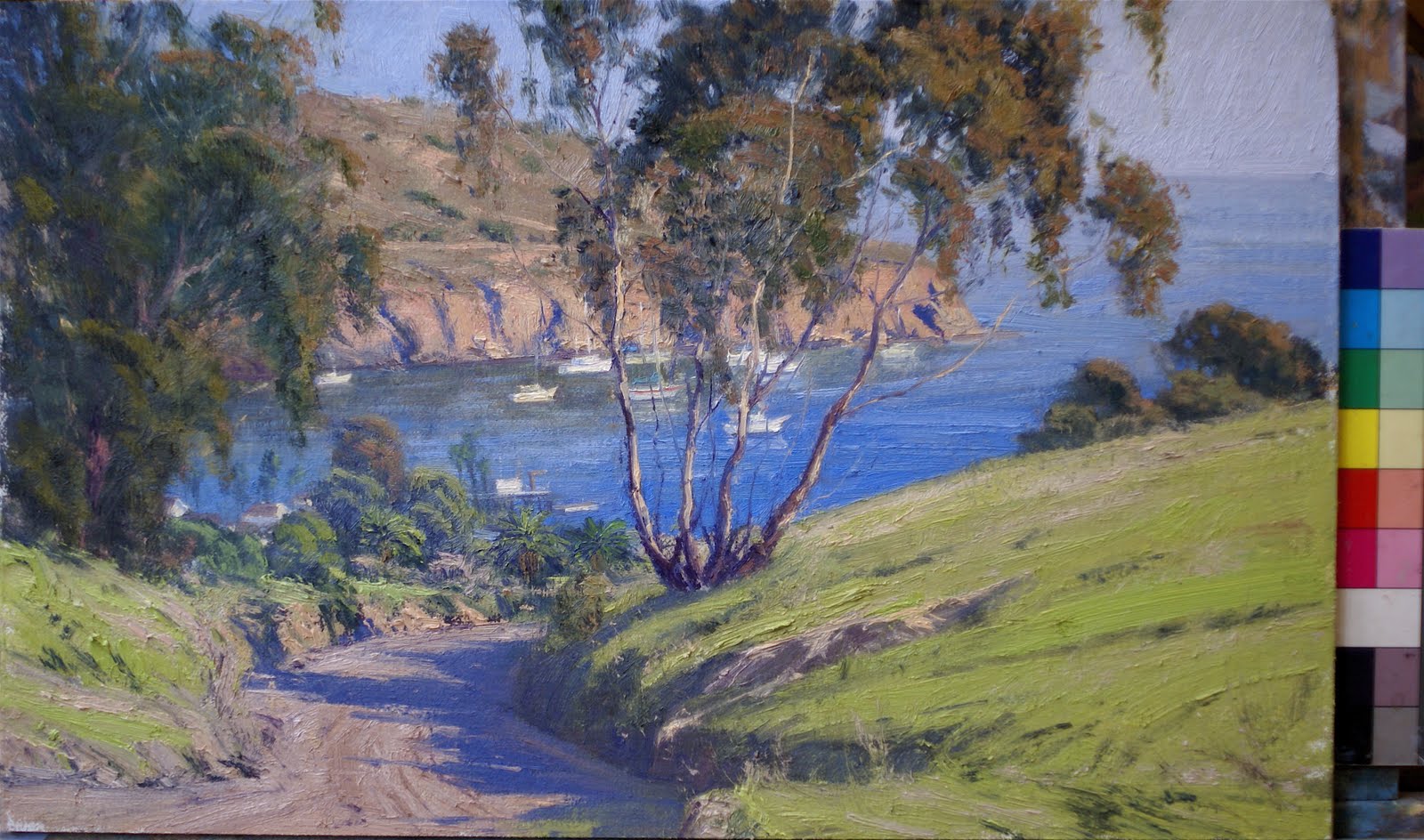
A: Catalina Island is one of my favorite places to paint. The interior of the island is like old California. There are a few paintings of the island I feel good about. To choose just one is almost impossible. This painting Spring Forward is of Two Harbors, Catalina Island. My inspiration usually comes from light and atmosphere.

Q: Do you have a favorite brand of paints, brushes, or canvas that you use?
A: Robert Simmons Signet series is a favorite brush of mine. Most oil brands are fine. My personal preference depends on the color. I especially like Grumbacher brand for Cerulian Blue Hue, Cad Yellow Orange and Thalo Yellow Green. For all the other colors I use one of the following brands: Utrecht, Grumbacher, or Gamblin.

Q: What advice do you have for artists seeking to improve their work?
A: Never settle! 


Monday, May 23, 2011

The Truth about Painting with Stan Miller

Stan Miller will be teaching a five-day workshop at Whidbey Island FineArt Studio (WIFAS) next month. He has been a professional painter in watercolor and egg tempera for more than thirty years. His theme will be “Painting the Portrait and Landscape.” Stan will demonstrate the landscape and the portrait, using a variety of styles and approaches, from realism to impressionism to abstraction. Stan recently shared the following information about himself and his painting in this interview.

Q: When did your interest in art begin and how long have you been an artist?
A: My interest in art began when I was a young child.  I've always loved art. I've been a professional, full time artist, since 1973.


Q: What do you seek to communicate through your art or your art instruction?
 A: I try to communicate through my art, first of all, peace and quiet, and then the sacred space.  I also like painting things that have a feeling of character and history: old people, old things, Venice, etc.  I think this is in part why I love to visit with old people.  I like Europe because of its character, its history.  

In my instruction I try most to teach students this truth, 'that all people can learn how to paint....painting is a language that everyone can learn if properly instructed'.  Once a student understands that painting is a learnable language and that they can learn to paint, I then try to teach each student to be true to their character and paint the subject that moves them, in the style that matches their temperament.  Whether, abstract, impressionism or realism...all these styles can be learned.  Like poetry, the short story or the novel...  Then, I warn them...that if they really want to be good, they have to have passion and work very hard for a long time...  I also remind them that the arts make life worth living; art opens our eyes and ears to the deeper beauty of our world...


Q: What drives you as an artist?
A: Every soul wants to he heard, and understood.  To do this, they must choose a method of communicating.  The artist uses their instrument, mine is painting, to express the deeper aspects, beyond our daily language, of what they want to share.  To want to share, be heard, understood...is what drives not only me, but all of humanity...

Q: What advice do you have for artists seeking to improve their work?
A: For artists who wish to improve their work, paint more...paint harder...and enjoy it!


Friday, April 22, 2011

Learning from a Master

Steve Whitney, a northwest landscape artist who also enjoys portraits, figurative work, and still life, recently enrolled in Jeff Legg’s workshop to learn how a master of still life approaches his work. Steve found that the workshop delivered everything he was looking for. 

 
After the workshop, Steve wrote down what he had learned. He was gracious enough to share his list us and now you can read it also.

Tips from Jeff Legg’s still life workshop:
  • For chiaroscuro effects, it’s usually best to place your light source just above and slightly in front of the setup, so that the subject is spotlighted.
  • If you can’t have natural daylight, use a full spectrum bulb at 5500 K.
  • Arrange some objects in half light and some in shadow for drama and mystery.
  • Using alkyd medium from first to last promotes quick drying, eliminates fat-over-lean problems, provides a nice luster, and makes oil out unnecessary. For slower drying with the other advantages, use another medium. This applies to all paintings, not just still life.
  • The still-life boxes should have a top for adjusting lighting.
  • Still life can be thematic or purely formal, with objects chosen solely for reasons of color, shape, size, and texture.
  • Block in the still life by massing shapes rather than by drawing their outlines.
  • Wherever possible, paint objects using horizontal rather than vertical strokes, as this prevents the formation of paint ridges along their boundaries.
  • Smooth grounds accommodate all painting styles from realistic to impressionistic. Jeff prefers smoothly gessoed Masonite (even smoother than Ampersand Gessoboard).
  • Tone the ground and let it dry before painting. Jeff likes a combination of raw umber and cobalt blue. Avoid making the tone too uniform.
  • Consider composing the still life as a vignette, with the borders of the painting less finished. When using this approach, it is still necessary to pay attention to the shapes of the less finished portions of the painting to assure that they complement the composition.


Steve has this to say about Whidbey Island Fine Art Studio workshops, “The atmosphere was casual and friendly, yet the students were all serious and experienced painters dedicated to the ongoing improvement of their work. I'm looking forward to the Liberace workshop this summer! May all your workshops and classes fill to the brim!”
We hope so too, Steve, and thanks for sharing what you learned with us.