Monday, August 8, 2011

Painting with Feeling

Mary Whyte is known for her large-scale watercolor paintings. A resident of Johns Island in South Carolina, Mary is noted for her depictions of African-American Gullah women (descendents of coastal Carolina slaves). 


A few years ago, Mary realized that a large segment of our population works unnoticed, year after year, in all kinds of jobs that are becoming outmoded, downsized, or phased out. She then turned her attention to painting southern laborers. Her exhibition of fifty paintings and drawings called “Working South” is currently on tour with several museums and featured in her book Working South: Paintings and Sketches.

As an artist, Mary has learned many lessons over the years—both about art and about life. She has shared many of these lessons in the books she has written. Her latest book, Painting Portraits and Figures in Watercolor releases in December.


As an art instructor, Mary believes that the techniques of watercolor painting can be learned. It can be tricky since watercolor is the only medium that relies strictly on timing. While the skill of painting with watercolors can be taught, Mary believes, “skill is never enough. One must also learn to feel as well as to see in order to become a complete artist and a complete person.”

Mary teaches art workshops all over the United States. We are privileged to have her come teach at Whidbey Island Fine Art Studio in October. We are excited to have her teach us watercolor technique as well as to help us capture our feelings in our paintings. After all, Mary believes that your paintbrush is not just an extension of your hand, but an extension of your soul as well.


Monday, July 11, 2011

Painting Figures with Aleah Chapin

Aleah Chapin will be teaching a five-day workshop on Beginning Figure Painting in oil at Whidbey Island Fine Art Studio (WIFAS) next month. This is a great workshop for teenagers, but adults are welcome to attend also. Aleah is a Northwest native and is currently a working on acquiring a Master of Fine Art at the New York Academy of Art.

Read our recent interview with Aleah to get a feel for who she is as an artist.


Q: When did your interest in art begin and how long have you been an artist?
A: I don't have an exact age that I became an artist. Really, it’s been my whole life. Every kid likes to draw; I just never stopped liking it. My mom is an artist and taught me a lot when I was young and both my parents have always been very supportive. My birthday presents were art books and art supplies. I suppose I became more serious about it though in high school when I was studying with a local island artist named Pete Jordan.

Q: What do you seek to communicate through your art or your art instruction?
A: In my art and in my teaching I hope to communicate the pure joy of creating. Yes, there are those difficult times, but as a whole, being able to play with color all day is such an incredible feeling. I hope the viewer can sense a bit of this. I also hope to create images that distill a sense of pathos, not necessarily sadness, but more about introspection. I want the viewer to feel connected to the person I am painting.

Q: What drives you as an artist?
A: Something that I cannot put into words. Right now I am living in Germany. I’ve been here for less than a week, but standing in front of a canvas with my palette and brushes I feel completely at home. being an artist doesn’t feel like a choice I made one day. It just feels right to mush beautiful pigment around on a white surface. So what drives me is the feeling of completeness I get when painting.


Q: What is a recent piece of art you created and what inspired you to paint it?
A: Instead of describing a specific piece, I will talk about what generally inspires me. This is because I don’t get ideas from a certain story or idea and then illustrate them. Its more of a feeling. I know I keep using the word “feeling” but this is really the only way I can describe it. When I paint, or am beginning the idea for a painting, I divorce myself from the part of my brain that uses words and where things are solid. I try to create images that come from a place away from my conscious brain. When the idea for a painting is just beginning, its like I’m looking at something through deep water or fog or in a pitch black room. I search around for it until it is clear and then the “concept” and “meaning” of it grows organically out of the physical act of painting. 

Q: Do you have a favorite brand of paints, brushes, or canvas that you use?
A: I like Old Holland paint a lot. Its texture is thicker and the paint is heavier. The colors are also gorgeous. With brushes its not a particular brand, but I use a lot of bristle rounds. Many of them have now become scratchy and worn down, which I love because it creates texture and lets the paint be a bit more free. I use canvas (not linen), and again am not picky on brand. I like a tighter weave and I gesso it about 7 times including 2 layers of oil primer at the end, sanding in between coats. Surface quality is one of the most important things in a painting for me.


Q: What advice do you have for artists seeking to improve their work?
A: Look at art. Look at all styles from all times: contemporary and traditional. Think about why you like one thing or dislike another. Study with as many different artists as possible and know that no one person has the answer to what makes “good” art. Although this can be a bit confusing at first, it will help you discover your own visual vocabulary and once you feel strong in that, then everyone else will believe it too. Don’t think too much. Just paint, paint, paint. Don’t be frustrated when it's not “perfect”. Let accidents happen. Don’t try to control them too much. Some of my best paintings have come out of accidents.

Q: What do you think is unique about Whidbey Island Fine Art Studio’s workshops?
A: The incredible, supportive and intimate community that you become part of. 


Monday, June 13, 2011

Plein Air with John Budicin

John Budicin will be teaching part of the five-day Plein Air workshop at Whidbey Island Fine Art Studio (WIFAS) next month. Born in Italy, John was 11 when his family moved to Southern California. John has won many awards and honors for his work and he is willing to share his award-winning techniques with you.

Read our recent interview with John to get a feel for who he is as an artist.

 
Q: When did your interest in art begin and how long have you been an artist?
A: My interest in art began when I was a young child. I have been in the art field since 1969. I began as an apprentice doing layouts and then I became the art director. I then worked doing illustrations before devoting all my time to fine art.

Q: What do you seek to communicate through your art or your art instruction?
 A: I teach plein air. I stress is shapes, values and design. I believe you should begin with a simple statement and do not chase the light. I have always found painting outdoors to be exhilarating.  Mother Nature is the best teacher, and if you make a commitment to be out there day after day, she will "speak" to you. 

Q: What drives you as an artist?
A: I am driven to do better today then what I did yesterday. I have painted in many different places including China. When I want to paint, I head out the door to find a scene that will spark my interest.  This may take hours, or it may take minutes.  What tends to catch my eye is the light—the pattern and contrast created on the subject, or the warm glow of a late afternoon bathing a particular landscape.  I'll sometimes drive around, searching everywhere for the right spot, or it may be right in front of me, waiting to be painted.  


Q: What is a recent piece of art you created and what inspired you to paint it?
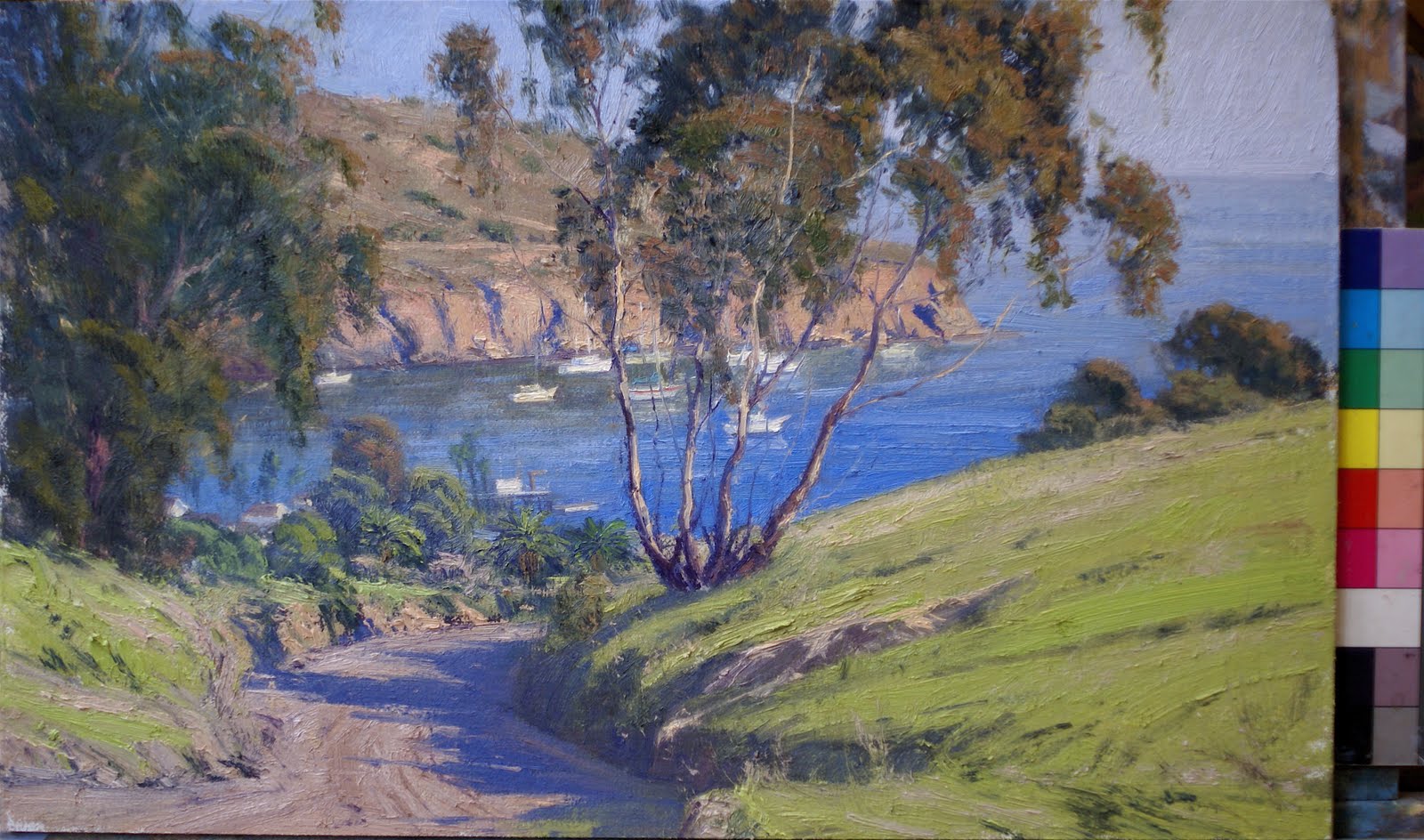
A: Catalina Island is one of my favorite places to paint. The interior of the island is like old California. There are a few paintings of the island I feel good about. To choose just one is almost impossible. This painting Spring Forward is of Two Harbors, Catalina Island. My inspiration usually comes from light and atmosphere.

Q: Do you have a favorite brand of paints, brushes, or canvas that you use?
A: Robert Simmons Signet series is a favorite brush of mine. Most oil brands are fine. My personal preference depends on the color. I especially like Grumbacher brand for Cerulian Blue Hue, Cad Yellow Orange and Thalo Yellow Green. For all the other colors I use one of the following brands: Utrecht, Grumbacher, or Gamblin.

Q: What advice do you have for artists seeking to improve their work?
A: Never settle! 


Monday, May 23, 2011

The Truth about Painting with Stan Miller

Stan Miller will be teaching a five-day workshop at Whidbey Island FineArt Studio (WIFAS) next month. He has been a professional painter in watercolor and egg tempera for more than thirty years. His theme will be “Painting the Portrait and Landscape.” Stan will demonstrate the landscape and the portrait, using a variety of styles and approaches, from realism to impressionism to abstraction. Stan recently shared the following information about himself and his painting in this interview.

Q: When did your interest in art begin and how long have you been an artist?
A: My interest in art began when I was a young child.  I've always loved art. I've been a professional, full time artist, since 1973.


Q: What do you seek to communicate through your art or your art instruction?
 A: I try to communicate through my art, first of all, peace and quiet, and then the sacred space.  I also like painting things that have a feeling of character and history: old people, old things, Venice, etc.  I think this is in part why I love to visit with old people.  I like Europe because of its character, its history.  

In my instruction I try most to teach students this truth, 'that all people can learn how to paint....painting is a language that everyone can learn if properly instructed'.  Once a student understands that painting is a learnable language and that they can learn to paint, I then try to teach each student to be true to their character and paint the subject that moves them, in the style that matches their temperament.  Whether, abstract, impressionism or realism...all these styles can be learned.  Like poetry, the short story or the novel...  Then, I warn them...that if they really want to be good, they have to have passion and work very hard for a long time...  I also remind them that the arts make life worth living; art opens our eyes and ears to the deeper beauty of our world...


Q: What drives you as an artist?
A: Every soul wants to he heard, and understood.  To do this, they must choose a method of communicating.  The artist uses their instrument, mine is painting, to express the deeper aspects, beyond our daily language, of what they want to share.  To want to share, be heard, understood...is what drives not only me, but all of humanity...

Q: What advice do you have for artists seeking to improve their work?
A: For artists who wish to improve their work, paint more...paint harder...and enjoy it!


Monday, May 2, 2011

Painting with Anne Belov

Anne Belov will be teaching a two-day workshop at Whidbey Island Fine Art Studio (WIFAS) later this month. Her theme will be “Finding the Light in Interiors.” The class will focus on creating a believable sense of illumination in your painting. Anne recently shared the following information about herself and her painting in this interview. I hope you enjoy learning about Anne.

Q: When did your interest in art begin and how long have you been an artist?
A: I know it sounds like a cliché, but I always wanted to make pictures. I think I knew by the time I was 5 or 6 that I wanted to be an artist.


Q: What do you seek to communicate through your art or your art instruction?
 A: Through my work, I want to communicate my understanding and appreciation of the world around me. My work is not about reporting, but about creating a believable fiction. I believe that it is important for those of us who have learned a lot over the decades to pass on what we have learned to others. People often ask if I worry that then my students will take that information and then copy my work. To that I reply that technical information is filtered through each person’s unique experience. Even if they “did exactly as I do” the work would be different than mine.

Q: What drives you as an artist?
A: My mortgage. Okay, I also enjoy painting.

Q: What is a recent piece of art you created and what inspired you to paint it?
A: I am almost always attracted to a particular image because of the way light falls on it, or the way that objects, angles and colors interact with one another. It is usually through these abstract principles that some personal truth or emotion reveals itself. I recently painted some peonies on a table set for a garden picnic.


Q: Do you have a favorite brand of paints, brushes, or canvas that you use?
A: I use Vasari oil paints. They are made in small batches with no fillers. They are yummy. I usually stretch my own linen canvases, because I like to work on portrait linen glued to a hard board.

Q: What advice do you have for artists seeking to improve their work?
A: I wish I had an easier answer, but really, the only thing that will improve your work is to do more of it. Having your work critiqued by a fresh eye also helps, but there are no formulas. Just do it. Another good way to improve your work is to look at art that attracts and inspires you. And, of course, take my class.

Q: What do you think is unique about Whidbey Island Fine Art Studio’s workshops?
A: Cary Jurriaans has created a beautiful space to work. She takes a lot of care with all the little details and has assembled a wonderful pool of instructors to teach. These are artists who are out there doing the work, and so they are on a perpetual voyage of discovery in their creative work. Artists that are actively involved in creating their own work have the most to offer a serious student.


Friday, April 22, 2011

Learning from a Master

Steve Whitney, a northwest landscape artist who also enjoys portraits, figurative work, and still life, recently enrolled in Jeff Legg’s workshop to learn how a master of still life approaches his work. Steve found that the workshop delivered everything he was looking for. 

 
After the workshop, Steve wrote down what he had learned. He was gracious enough to share his list us and now you can read it also.

Tips from Jeff Legg’s still life workshop:
  • For chiaroscuro effects, it’s usually best to place your light source just above and slightly in front of the setup, so that the subject is spotlighted.
  • If you can’t have natural daylight, use a full spectrum bulb at 5500 K.
  • Arrange some objects in half light and some in shadow for drama and mystery.
  • Using alkyd medium from first to last promotes quick drying, eliminates fat-over-lean problems, provides a nice luster, and makes oil out unnecessary. For slower drying with the other advantages, use another medium. This applies to all paintings, not just still life.
  • The still-life boxes should have a top for adjusting lighting.
  • Still life can be thematic or purely formal, with objects chosen solely for reasons of color, shape, size, and texture.
  • Block in the still life by massing shapes rather than by drawing their outlines.
  • Wherever possible, paint objects using horizontal rather than vertical strokes, as this prevents the formation of paint ridges along their boundaries.
  • Smooth grounds accommodate all painting styles from realistic to impressionistic. Jeff prefers smoothly gessoed Masonite (even smoother than Ampersand Gessoboard).
  • Tone the ground and let it dry before painting. Jeff likes a combination of raw umber and cobalt blue. Avoid making the tone too uniform.
  • Consider composing the still life as a vignette, with the borders of the painting less finished. When using this approach, it is still necessary to pay attention to the shapes of the less finished portions of the painting to assure that they complement the composition.


Steve has this to say about Whidbey Island Fine Art Studio workshops, “The atmosphere was casual and friendly, yet the students were all serious and experienced painters dedicated to the ongoing improvement of their work. I'm looking forward to the Liberace workshop this summer! May all your workshops and classes fill to the brim!”
We hope so too, Steve, and thanks for sharing what you learned with us.


Monday, April 11, 2011

Grape Demonstration with Jeff Legg

We recently hosted a three-day workshop with Jeff Legg, an honored award-winning Oil Painter of America Master.  During this three-day class, Jeff demonstrated his approach to still life from the concept to set up and lighting and the progression to the finished work.

One demonstration Jeff provided for the class was of a cluster of grapes. In the following photos, you can see his progression from the initial blocking in the masses to the finishing touches.

This first photo shows blocking in the masses.


This second photo is where Jeff started to bring out the grapes from the mass and added some highlighting of the individual grapes.


In this third photo, Jeff added some green while still carefully observing the grapes.

 
Then he added the “magic” blush to the grapes.


Finally, through some added transparency, the painting took shape.


Of course, a finished painting will take much more time and work than a demonstration, but these photos can give you an idea of the progression Jeff demonstrated. Watching a master demonstrate techniques is a great way to learn to incorporate new techniques into your own paintings.