
The Mona Lisa
from the http://arthistoryblogger.blogspot.com/2012/12/the-mona-lisa.html?view=timeslide
by Carol Hendricks, she
Carol will be coming for some art history lectures to Whidbey Island soon, keep checking out our website!!
The Mona Lisa painted by Leonardo da Vinci (1452-1519) in 1503 is probably the most famous work of art in the world. Why has the Mona Lisa become so famous? Let's examine what it is that makes this rather small (30.31 x 20.87 in, 77 x 53 cm) oil painting on a wood panel painted at the turn of the 16th century so compelling to viewers worldwide.


But Leondardo was not the first to use the 3/4 view, here is another portrait by Ghirlandaio which is similar to the Mona Lisa in composition. The sitter also sits on a balcony and has a panoramic landscape behind her. Yet this work too does not match the realism of the Mona Lisa. One reason is that Leonardo's use of oil paint gives his work a richness of color and sense of depth that cannot be achieved with egg tempera.

The artist Perugino was a contemporary of Leonardo da Vinci, it is thought that they both studied under the same master, Andrea del Verrochio. In the above portait Perugino also uses a similar composition, his sitter seems to rest his hands on the frame of the painting and again we see a sweeping (if not Italian) landscape in the far background. Perugino worked in oil paints and he has captured many lifelike details faithfully.
But why does the Mona Lisa still look more lifelike? Leonardo pioneered several painting techniques, one was known as "chiaroscuro" which used light and dark to model form rather than using flatter outlines such as painters like Ghirlandaio and Perugino. Leonardo's other innovative technique of "sfumato" meaning smoke created a painting with many thin glazes or layers of oil paint rather than the bright and flat washes of egg tempera. Leonardo also famously dissected corpses to do a thorough study of human anatomy, which allowed him to fully understand the facial structure of his model and the underlying muscle and skeletal structures of all the figures he drew and painted.


When we line them up side by side these comparisons can help the modern viewer see the Mona Lisa with fresh eyes and fully appreciate the work for the innovative type of portrait that it was. At this time portraiture was rather common and many painters contributed a variety of techniques.
But in fact there have been many innovative painting styles and techniques through the ages and Leonardo himself painted a number of other well executed portraits. This leads back to my examination of the fame behind this now iconic work.
Leonardo da Vinci was considered to be a genius in his own time and he still is. He did work as a painter, but he also worked on a wide variety of other things and so didn't create very many paintings, only around 25 exist today. Therefore his unique painting methods combined with the scarcity of his work means that each work is considered extremely valuable and that sentiment has been true of Leonardo for a long time.

That idea ties into yet another reason why the Mona Lisa is so famous, the scandal that was created when it was stolen from the Louvre over 100 years ago.
The "Cult of the Mona Lisa" so to speak may have begun in 1911 the year it was stolen from the museum. King François I of France invaded the Duchy of Milan while Leonardo was employed in the Royal Court of Milan under Sforza rule. The French king was quite impressed with Leonardo and brought him back to France with him. As Leonardo had never given his portrait of the Mona Lisa to his patron, he brought it and other works with him to France where he lived out the remainder of his life. Due to this the Louvre museum in Paris has an impressive number of his works in its collection, at least six paintings as well as dozens of drawings.
That very fact angered a man named Vincenzo Peruggia who was working at the Louvre, he was Italian and felt that the Mona Lisa should be returned to Italy. As an employee he was able to take it from the frame and sneak it out of the building. A day went by before workers realized it was in fact stolen and when word got out about the theft of the Mona Lisa the public was shocked. It was said that more people came to the Louvre to stare at the empty frame in the month it went missing than came to see the painting in the entire previous year.
It wasn't recovered for another two years and when it was finally returned the artwork was considered even more priceless and beloved than before. Today it hangs behind protective glass and is surrounded by a constant crowd of viewers.
It is one of the most copied and parodied works of art. Marcel Duchamp made a version in 1919 with a mustache and beard and Andy Warhol made a silkscreen in 1963 of multiple images entitled Thirty are Better than One.
Whether it is seen as a paragon of Renaissance beauty, an innovative work by a genius or an iconic painting, the Mona Lisa continues to intrigue and inspire viewers more than 500 years after Leonardo da Vinci painted her.
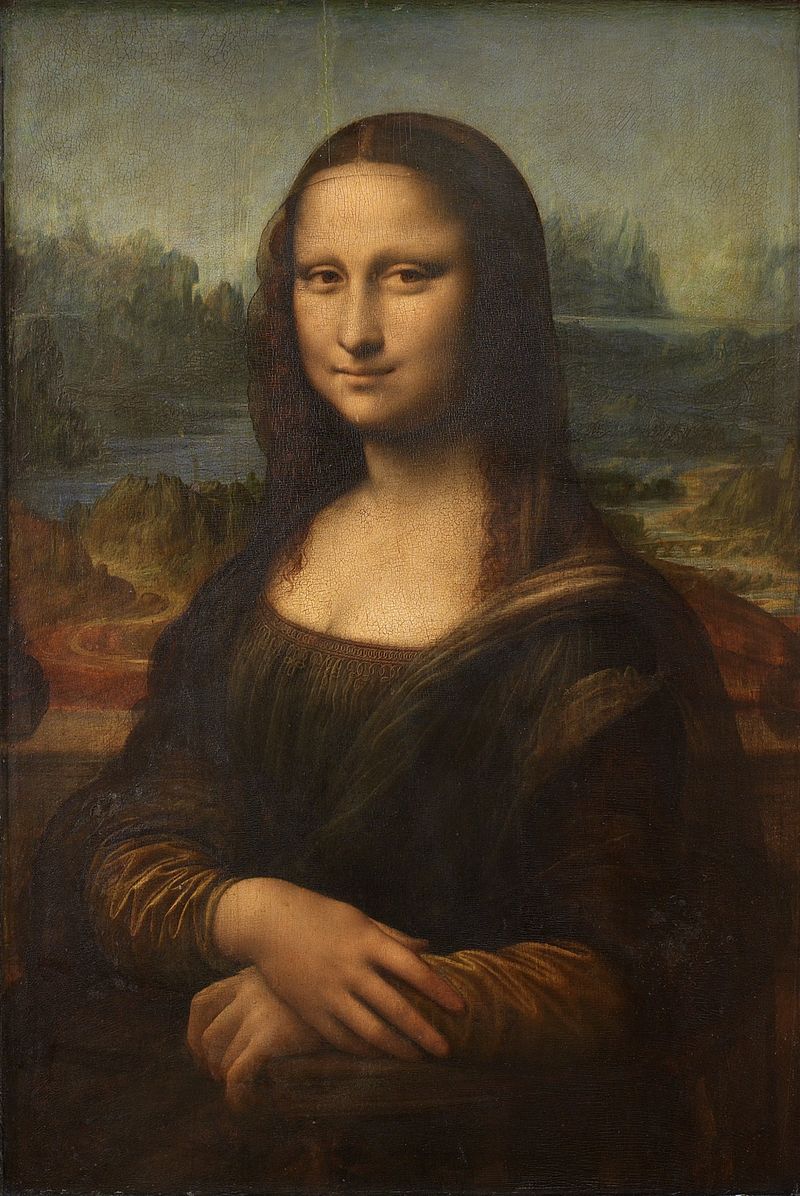 |
| Mona Lisa, (La Gioconda), Leonardo da Vinci, 1503-06, The Louvre |
The Mona Lisa is the portrait of Lisa Gherardini, the wife of Francesco del Giocondo. Mona was a contraction of "Madonna" meaning "my lady", a title of respect. In the Louvre where this is located the painting is called La Gioconda, this is both a feminine version of her husbands last name and a word in Italian that tranlates into "the joyful one" referring to her slight smile.
Leonardo was born and raised in Tuscany and studied art under Andrea del Verrochio in Florence. After leaving his master's workshop he acquired fame as an artist in Florence, where he lived until he was 30 years old. Then he was sent by the influential Medici family to live in Milan where he worked for both the Medici and Duke Lodovico Sforza. The Mona Lisa was painted during the three year period when Leonardo returned to Florence. It was commissioned by another Florentine, Francesco del Giocondo who was a wealthy silk merchant. Leonardo returned to Milan in 1506 and brought the portrait with him.
Leonardo had painted only a handful of private portraits in his career, some earlier works are below. From left we see the Portrait of Ginevra de'Benci (1474-78), a portrait known as the Lady with an Ermine (c-1490, thought to be the mistress of Lodovico Sforza the Duke of Milan, Cecilia Gallerani) and the unknown sitter called La belle Ferronière (1490-96).


While all are extraordinarily lovely portraits, the Mona Lisa still remains one of the most famous works of art in the world which leads me back to my original question- Why has the Mona Lisa become so famous?
Leonardo was born and raised in Tuscany and studied art under Andrea del Verrochio in Florence. After leaving his master's workshop he acquired fame as an artist in Florence, where he lived until he was 30 years old. Then he was sent by the influential Medici family to live in Milan where he worked for both the Medici and Duke Lodovico Sforza. The Mona Lisa was painted during the three year period when Leonardo returned to Florence. It was commissioned by another Florentine, Francesco del Giocondo who was a wealthy silk merchant. Leonardo returned to Milan in 1506 and brought the portrait with him.
Leonardo had painted only a handful of private portraits in his career, some earlier works are below. From left we see the Portrait of Ginevra de'Benci (1474-78), a portrait known as the Lady with an Ermine (c-1490, thought to be the mistress of Lodovico Sforza the Duke of Milan, Cecilia Gallerani) and the unknown sitter called La belle Ferronière (1490-96).


All three are beautifully painted with oil on a wood panel and show the sitter in a 3/4 view. I have arranged them in the order they were painted chronologically and the Mona Lisa would have been painted nearly 10 years after La belle Ferronière and 25 years after the de'Benci portrait. The later two have no background which highlights the face of the sitter, the earlier work had the landscape background made popular in Florentine painting of the mid to late 15th century.
While all are extraordinarily lovely portraits, the Mona Lisa still remains one of the most famous works of art in the world which leads me back to my original question- Why has the Mona Lisa become so famous?
One reason this is so well known is that this portrait was painted using techniques ahead of its time. When compared with portraits by other artists painted around this time the Mona Lisa is startlingly realistic. Let's look at some examples of Italian Renaissance portrait painting from the late 15th century.

Giovanna Tornabuoni, Ghirlandaio, 1489-90, tempera on panel,
Thyssen-Bornemisza Museum (Madrid)
We can compare the Mona Lisa to earlier egg tempera portraits such as the one by the well known Florentine painter Ghirlandaio (above). The style he used in his portrait of Giovanna Tornabuoni was quite popular during the 1400's, the profile was influenced by Ancient Roman coins which were commonly collected in the Renaissance. The Mona Lisa was painted less then 15 years later, Leonardo uses the more realistic 3/4 view of his sitter. In comparison to the lovely portrait of Giovanna Tornabuoni, the Mona Lisa is a much more convincingly naturalistic representation.

But Leondardo was not the first to use the 3/4 view, here is another portrait by Ghirlandaio which is similar to the Mona Lisa in composition. The sitter also sits on a balcony and has a panoramic landscape behind her. Yet this work too does not match the realism of the Mona Lisa. One reason is that Leonardo's use of oil paint gives his work a richness of color and sense of depth that cannot be achieved with egg tempera.

Portrait of Francesco delle Opere, Perugino, 1494, Uffizi Gallery (Florence)
The artist Perugino was a contemporary of Leonardo da Vinci, it is thought that they both studied under the same master, Andrea del Verrochio. In the above portait Perugino also uses a similar composition, his sitter seems to rest his hands on the frame of the painting and again we see a sweeping (if not Italian) landscape in the far background. Perugino worked in oil paints and he has captured many lifelike details faithfully.
But why does the Mona Lisa still look more lifelike? Leonardo pioneered several painting techniques, one was known as "chiaroscuro" which used light and dark to model form rather than using flatter outlines such as painters like Ghirlandaio and Perugino. Leonardo's other innovative technique of "sfumato" meaning smoke created a painting with many thin glazes or layers of oil paint rather than the bright and flat washes of egg tempera. Leonardo also famously dissected corpses to do a thorough study of human anatomy, which allowed him to fully understand the facial structure of his model and the underlying muscle and skeletal structures of all the figures he drew and painted.


When we line them up side by side these comparisons can help the modern viewer see the Mona Lisa with fresh eyes and fully appreciate the work for the innovative type of portrait that it was. At this time portraiture was rather common and many painters contributed a variety of techniques.
But in fact there have been many innovative painting styles and techniques through the ages and Leonardo himself painted a number of other well executed portraits. This leads back to my examination of the fame behind this now iconic work.
Leonardo da Vinci was considered to be a genius in his own time and he still is. He did work as a painter, but he also worked on a wide variety of other things and so didn't create very many paintings, only around 25 exist today. Therefore his unique painting methods combined with the scarcity of his work means that each work is considered extremely valuable and that sentiment has been true of Leonardo for a long time.

That idea ties into yet another reason why the Mona Lisa is so famous, the scandal that was created when it was stolen from the Louvre over 100 years ago.
The "Cult of the Mona Lisa" so to speak may have begun in 1911 the year it was stolen from the museum. King François I of France invaded the Duchy of Milan while Leonardo was employed in the Royal Court of Milan under Sforza rule. The French king was quite impressed with Leonardo and brought him back to France with him. As Leonardo had never given his portrait of the Mona Lisa to his patron, he brought it and other works with him to France where he lived out the remainder of his life. Due to this the Louvre museum in Paris has an impressive number of his works in its collection, at least six paintings as well as dozens of drawings.
That very fact angered a man named Vincenzo Peruggia who was working at the Louvre, he was Italian and felt that the Mona Lisa should be returned to Italy. As an employee he was able to take it from the frame and sneak it out of the building. A day went by before workers realized it was in fact stolen and when word got out about the theft of the Mona Lisa the public was shocked. It was said that more people came to the Louvre to stare at the empty frame in the month it went missing than came to see the painting in the entire previous year.
It wasn't recovered for another two years and when it was finally returned the artwork was considered even more priceless and beloved than before. Today it hangs behind protective glass and is surrounded by a constant crowd of viewers.
It is one of the most copied and parodied works of art. Marcel Duchamp made a version in 1919 with a mustache and beard and Andy Warhol made a silkscreen in 1963 of multiple images entitled Thirty are Better than One.
Whether it is seen as a paragon of Renaissance beauty, an innovative work by a genius or an iconic painting, the Mona Lisa continues to intrigue and inspire viewers more than 500 years after Leonardo da Vinci painted her.
Carol Hendricks


